The Stories You Tell Yourself — And How To Rewrite Them
Every pattern you keep returning to makes sense if you understand the story underneath it. Not the conscious narrative — not 'I know I should ask for more', but the one running a layer below that, the one that was formed long before you had the language for it.
Stories like: I am too much. I am not enough. I need to earn my place in the room. If I'm too visible, something will be taken from me. People leave. I'm only lovable when I'm useful. Success means something bad will happen.
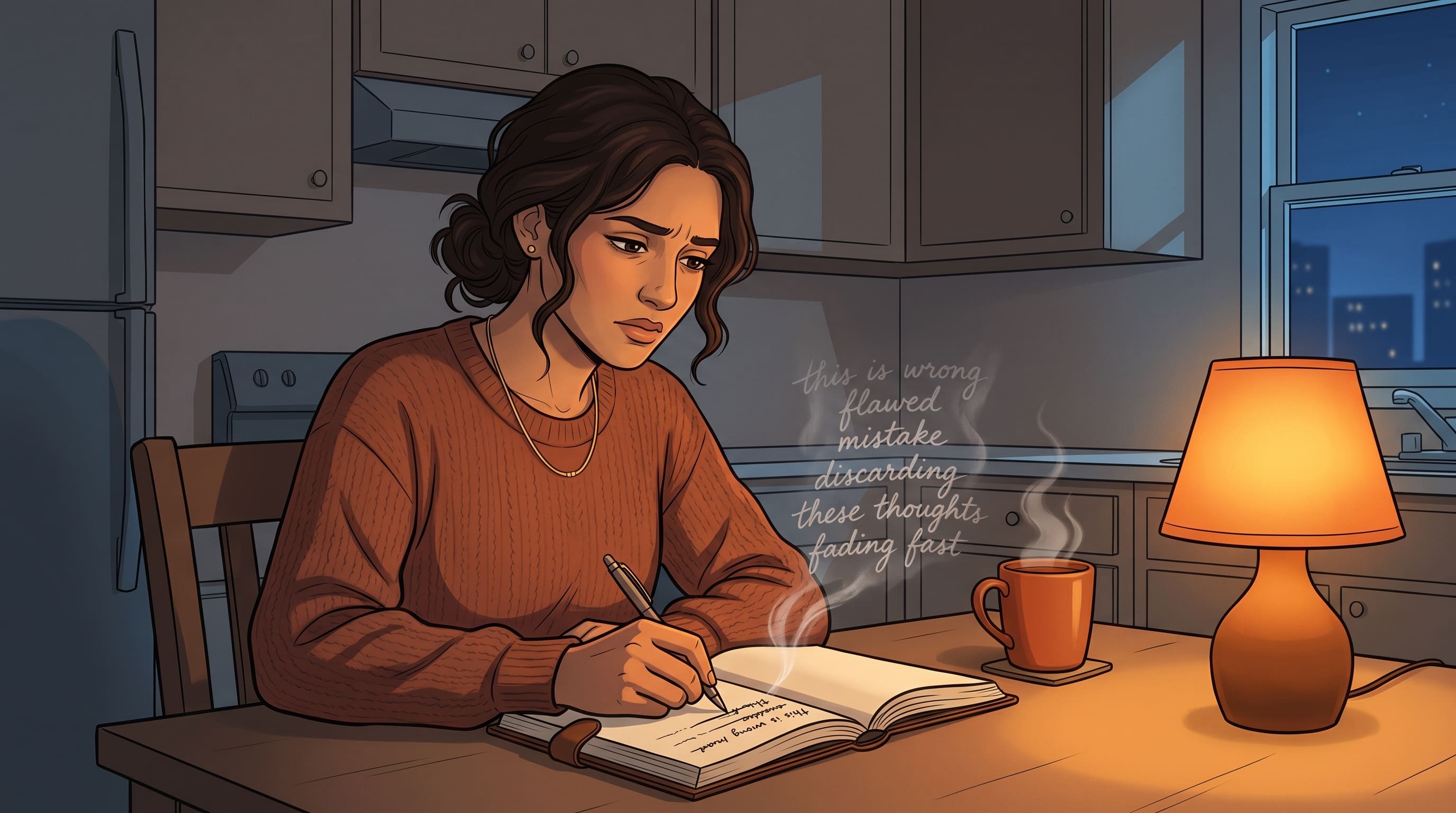
These aren't delusions. They're conclusions drawn from real experiences, often early ones. The problem isn't that you had them — it's that they were written when you were small and powerless and had very limited data, and most of us are still living from them at 30 as if they're still true.
The most powerful work you will ever do is not changing your behaviour. It's examining the belief that generated the behaviour, and asking whether you still consent to it.
This is the work that therapists do well, and this guide is not a replacement for therapy. But there are things you can do on your own that create genuine clarity.
The first is simply to notice — when you react to something more strongly than the situation warrants, when you shrink in a room where you have every right to take up space, when you accept less than you'd counsel a friend to accept — something is being narrated underneath. Catching those moments is the beginning.
The second is to ask: where did I learn this? Not to blame, but to understand the origin. A belief that came from a nine-year-old's interpretation of a painful event is not a law. It's a theory, formed under pressure, by someone without the full picture. You have more data now.
The third — and hardest is to ask: do I still consent to this story? Because we tend to live from our oldest stories by default, not by choice. Choosing differently starts with noticing that you had a choice at all.
The Stories Most Worth Examining
- I'm not ready yet. This story keeps you perpetually in preparation. Readiness is a feeling — not a prerequisite. The women who do the things they're afraid of don't feel ready. They go anyway.
- I don't want to seem too much. Too loud, too ambitious, too needy, too sensitive. This story was probably useful once — it kept you safe or likeable in an environment where being too much had a cost. It may no longer serve you. In fact, the relationships and rooms where you have to make yourself less are telling you something.
- If it goes well, something will go wrong. This one is sneaky because it sounds like superstition. But it runs underneath self-sabotage, the inability to receive good things without immediately bracing for them to disappear. Often it comes from experiences where good things did disappear — and the brain generalised.
- I have to earn my place. This one makes women work twice as hard and advocate for themselves half as much. The earning never feels complete because the story doesn't have a finish line. You are allowed to take up space without performing your way into it first.
Maya's Story, Traced Back
Maya's story was 'I am too much.' Not consciously — she would have denied it if you'd asked her directly. But it was visible in the pattern once she started looking: the way she softened her opinions in meetings when someone seemed uncomfortable, the apologies that came before she'd done anything wrong, the way two years had passed without her once asking Daniel a direct question about where things stood, because a direct question felt like too much to ask.
It traced back, she eventually understood, to a father whose approval felt conditional on Maya not being too emotional, too loud, too demanding — a small child learning early and completely that being manageable was the price of being loved. The lesson didn't stay in childhood. It had been running the show for two decades: at work, where 'too much' meant never naming her own achievements; with Daniel, where 'too much' meant never asking for the clarity she actually needed.
Noticing didn't make the story stop. But it created something new: a gap between the trigger and the automatic response. In that gap, for the first time, she had room to choose differently — not every time, but sometimes. And sometimes was new.
'I used to think the goal was to stop feeling like I was too much,' she said later. 'What actually helped was just seeing the thought arrive and recognizing it as a thought, an old one, with an origin — instead of a fact about who I was.'
Reflection · For your journal. No right answer — just write what's true.
1. What is the story you carry most consistently about what you deserve in love, in work, in how people treat you?
2. Where did you first learn that story? Not to blame anyone — just to understand the origin and see how old the data actually is.
3. What would a woman who had fully updated that story do differently this week? Name one specific behaviour, not a feeling.
Maya could name the story now. But naming it didn't yet change what she was accepting from Daniel, or asking for at work. The gap between seeing a pattern and actually enforcing a different standard is where most growth stalls out. Chapter 3 is about closing that gap.
Buy This Guide
Lifetime access to this guide.
Unlimited All-Access
Unlock all current & future guides.