The Long Game — Casting Votes For The Woman You're Becoming
There is a particular pressure that women in their late twenties and thirties feel — and it's not just about biological clocks or career timelines, though those are part of it. It's a deeper pressure: the sense that there's a schedule for becoming yourself, and you're behind it.
You should have healed by now. You should have figured out what you want. You should be in the relationship, the career, the house, the version of yourself that feels settled and purposeful and whole.
This schedule is not real. But it is relentless. And it creates a particular kind of frantic quality in how women approach growth — moving fast not because the pace serves them but because they're trying to outrun the feeling of being behind.
You overestimate what you can become in a year and dramatically underestimate what you can become in ten. The decade is where the real transformation happens. The work you're doing today is the compound interest of your future self.
The concept of compound interest applies to identity as directly as it applies to money. Every day you practice sitting with discomfort instead of running from it, you become slightly better at that. Every time you hold your standard, the standard becomes slightly more natural. Every time you choose yourself when it would have been easier not to, the choice becomes slightly more available to you.
None of this is visible in the moment. That's the nature of compounding — it's invisible in the short term and dramatic in the long term. This is why consistency is the most underrated ingredient in becoming who you want to be. Not grand gestures. Not transformative retreats. Just the daily, mostly boring, frequently imperfect practice of being slightly more intentional than you were yesterday.
Casting Votes
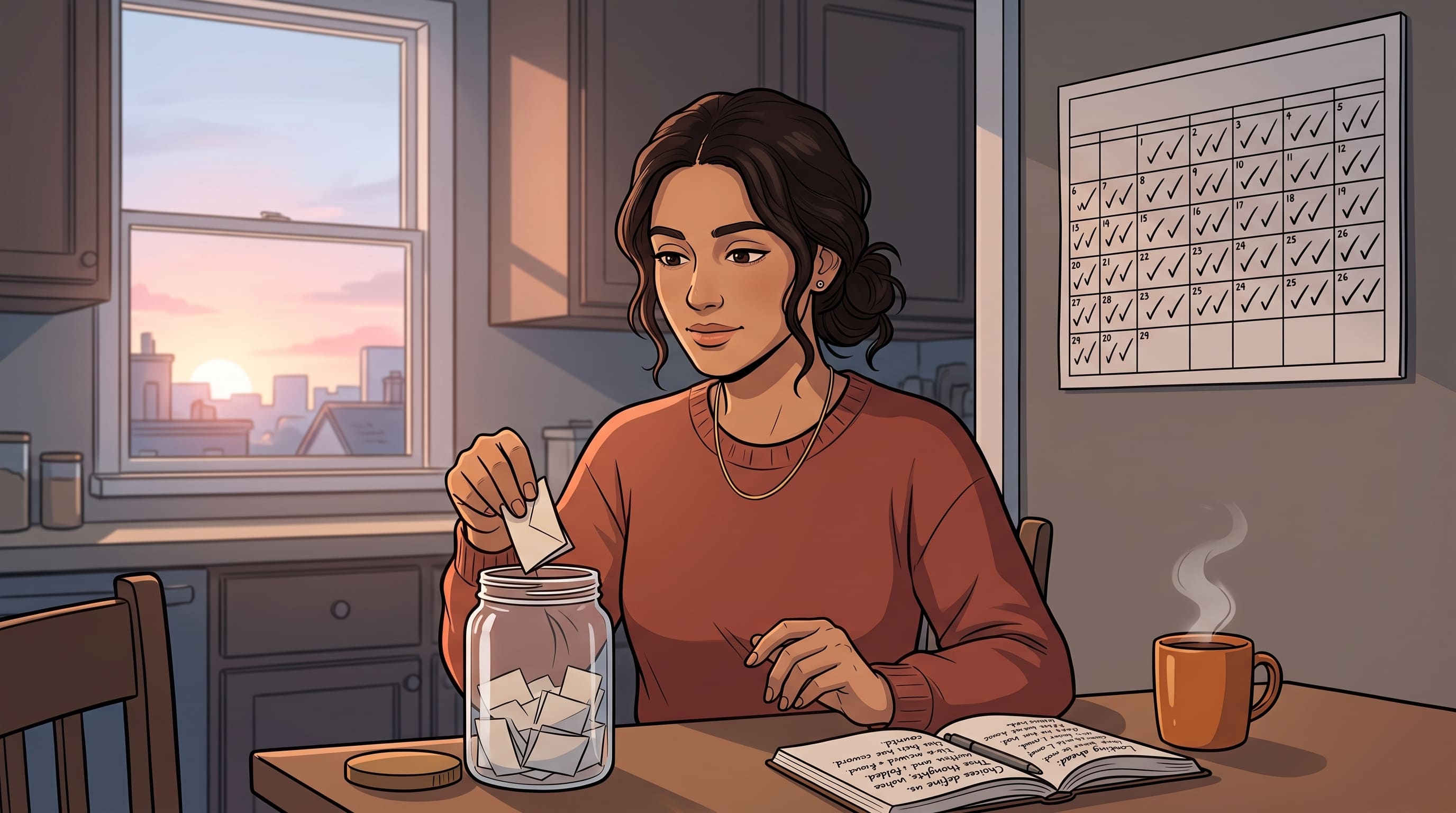
The frame that helps most people: every action you take is a vote for the woman you're becoming. Not a guarantee of the outcome — a vote. You vote for her when you speak when you would have been quiet. When you leave when you would have stayed. When you rest without guilt. When you tell the truth when it would have been easier to perform.
You don't need a unanimous election. You just need a consistent majority. Missing a day, breaking a commitment, reverting to an old pattern — these are not disqualifications. They're single votes. Cast the next one differently.
The women you admire for their groundedness, their clarity, their apparent ease with themselves — they didn't arrive there. They accumulated there. Thousands of small votes, many of them imperfect, across years. What you're seeing is the compound interest of practice, not a natural state they were born into.
Where Maya's Two Threads Landed
Six months after the dinner with Daniel and the conversation with her manager, both of Maya's long-running waiting games had resolved — not dramatically, but as the natural result of the votes she'd kept casting.
She didn't get the internal promotion. Her manager was honest: the company's structure wasn't going to open that path for at least another year, regardless of her performance. Six months earlier, that answer would have sent her back into quiet, resentful waiting. Instead, she used the external application she'd sent before she felt ready — and three months later accepted a director-level role at a different company, at a salary 30% higher than what she'd been making.
Daniel reached out once, a month after they'd ended things, in a message that was warm and a little wistful. Maya didn't reopen the conversation. Not out of coldness — the version of her from a year earlier would have read hope into that message and let it reopen everything. The version of her now recognised it for what it was: a nice message from someone who still hadn't answered the actual question.
Some days it was a big vote — sending the application, having the dinner-table conversation, requesting the meeting with her manager. Most days it was small: she went to the gym when she wanted to stay in bed. She asked a friend directly for what she needed instead of hinting. She didn't apologise for something that wasn't her fault.
'I spent years waiting for the big transformation,' she said. 'I thought becoming who I wanted to be would feel dramatic. It didn't. It felt like a few hundred small decisions, most of which nobody else ever saw.'
'But I saw them. And eventually they added up to someone I actually recognised — with a new job, an ended relationship that needed to end, and a version of myself who no longer waits to be noticed before she speaks.'
You're casting votes. You're building. And then — because it always does, eventually, something threatens to pull you backward. Not as punishment. Just as part of the sequence. Chapter 6 is about what happens when the past resurfaces and what to do instead of going back.
Buy This Guide
Lifetime access to this guide.
Unlimited All-Access
Unlock all current & future guides.