ATTACHMENT IN THE TEXTING ERA
Double-texting, read receipts, and the silence that isn't what you think it is.
Attachment theory was worked out long before anyone had to interpret a grey bubble, a “Read 9:47 PM,” or three dots that start typing and then stop. Texting didn't invent anxious and avoidant patterns — but it hands both of them a stage with no tone of voice, no facial expression, and a timestamp that's extremely easy to over-read.
The Double-Text
For an anxious texter, the urge to send a second message before the first one's been answered usually isn't really about the content of either text. It's an attempt to trade an uncomfortable feeling — uncertainty — for a comfortable one — an answer, any answer. The problem is that a double text often lands, on the other end, as pressure, which is close to the opposite of what actually earns a warm reply.
Avoidant texters rarely double-text at all, and when they do, it's almost always about logistics, not emotion — “also, can you grab milk” rather than “are we okay?” Secure texters double-text sometimes too, but casually, without much internal drama attached to it either way.
The fix isn't “never send a second text.” It's building a ten-minute pause between the urge and the action, and using that pause to ask what you actually need. Usually it's reassurance — and a second, softer message rarely provides that as well as simply waiting does.
Read Receipts and the “Seen Zone”
A “Read” timestamp with no reply is one of the most anxiety-triggering small artifacts of modern dating, because it removes the one charitable explanation available — “they haven't seen it yet” — and leaves only the uncharitable one — “they saw it and chose not to respond.”
In reality, reading a message and being ready to respond to it are two completely different states. Plenty of people read a text, feel a small flicker of I need to think about how to answer this properly, and then get pulled into the next thing life throws at them before they circle back. The read receipt tells you when they looked. It tells you nothing at all about why they haven't replied yet — but the anxious brain will happily fill that gap with the worst available story if you let it.
Response-Time Anxiety
The gap between sending a message and getting a reply is where a lot of attachment activity quietly happens, and each style experiences that gap very differently. A secure texter might notice the gap too, but doesn't build a story around it — a few hours without a reply is just a few hours, not evidence of anything. An anxious texter can genuinely track the minutes, with the discomfort climbing the longer the gap runs. An avoidant texter often barely registers the gap at all, and can be caught off guard to learn a few hours felt significant to someone else. A disorganized texter can experience both at once — checking the phone every few minutes, and then feeling annoyed at themselves for caring so much, in the same ten-minute stretch.
None of these reactions are a character flaw. They're just your attachment style showing up in a new format — which means the same fix applies: notice it, name it, and give it a few minutes before you act on it.
“Active Now,” Story Views, and Other Micro-Signals
Modern dating anxiety doesn't stop at text messages. An “Active now” indicator, a viewed Instagram story with no reply to your last message, a like on an old photo at 1 a.m. — these tiny, almost accidental signals can carry an enormous amount of imagined meaning. The honest truth is that most of them mean almost nothing on their own. People scroll social media in genuinely unrelated moments — waiting in line, avoiding a work task, unable to sleep — that have nothing to do with the person they haven't texted back yet.
The rule of thumb worth adopting: a single ambiguous signal is not evidence of anything. A clear, repeated pattern over weeks might be worth a direct conversation — not more detective work, an actual conversation.
Texting Styles, at a Glance
- Secure texters reply when they reasonably can, don't read much into normal gaps, and say so plainly if they're going to be slow for a while.
- Anxious texters may over-explain, seek reassurance indirectly, and feel real discomfort in ordinary silence.
- Avoidant texters tend to be brief, logistics-focused, and can go quiet without meaning anything by it.
- Disorganized texters may swing between warm and distant within the same conversation, sometimes within the same hour.
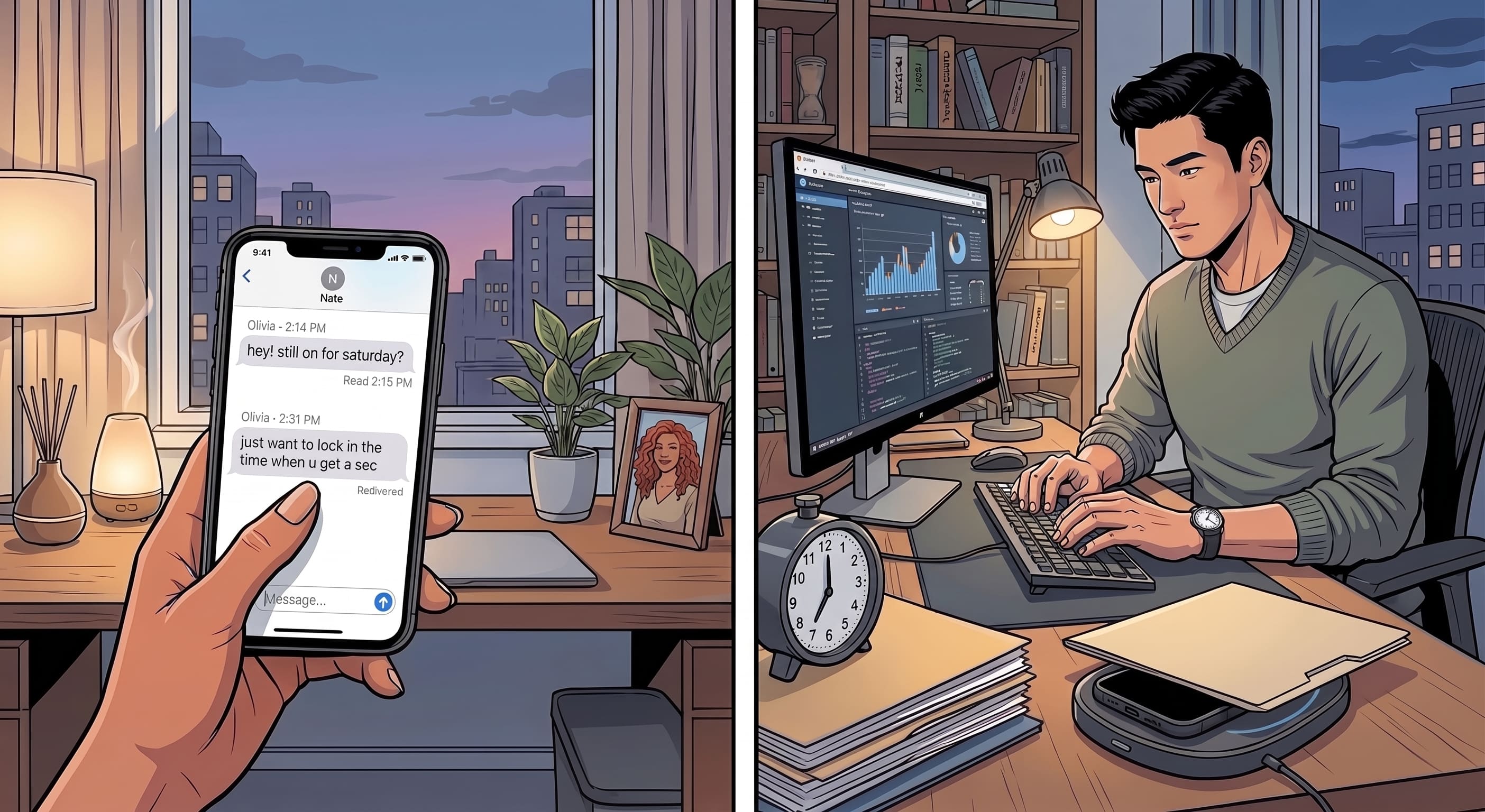
Olivia and Nate, Over Text
Olivia · 2:14 PM: hey! still on for saturday?
Olivia · 2:31 PM: just want to lock in the time when u get a sec
Read 2:33 PM · no reply for three hours
By 4 PM, Olivia has decided the silence means Nate is losing interest. By 5:30, Nate — buried in a deadline, phone on Do Not Disturb — finally surfaces, sees the read receipt sitting there, and feels a stab of guilt that makes him want to explain himself perfectly before replying at all, which delays the reply even further.
Nate · 5:41 PM: sorry — buried at work all afternoon, phone was off. still very on for saturday, just need today to pass lol
What actually happened had nothing to do with the relationship.
Nothing in that exchange was really about Saturday. It was two nervous systems filling a silence with their own worst-case story — exactly what silence does when there's no information available to fill it with instead.
A Second Exchange: The Repair
A few weeks later, after talking through the pattern above, a similar situation comes up. Nate has another heavy work day. This time, he sends one line before going quiet:
Nate · 11:02 AM: heads up, swamped today. I'll be here, just slow. talk tonight?
Olivia · 11:16 AM: got it, no rush. hope it calms down 💙
Same busy day. Completely different afternoon for both of them.
Nothing about Nate's workload changed. What changed was one sentence that turned an ambiguous silence into an explained one — which is the entire difference between an afternoon spent spiraling and an afternoon spent simply waiting.
A Digital Repair Phrase
Couples who navigate texting well tend to agree, in a calm moment, on a short phrase that means I'm not pulling away, I'm just underwater right now. Something as simple as a single word: “swamped,” or “here, later” — during a busy stretch does more for a partner's nervous system than silence ever will, and takes about four seconds to type.
A Texting Agreement Worth Actually Having
Most couples never explicitly discuss texting norms — they just discover each other's assumptions the hard way, usually mid-conflict. A short, direct conversation can prevent most of it. A few starting points:
- Reply within a reasonable window when you reasonably can — and agree on what “reasonable” roughly means for both of you.
- If you need longer than that, a three-second placeholder (“swamped, talk later”) beats total silence every time.
- Assume good intent for at least the first few hours of silence, by default, before building a theory.
- If texting anxiety keeps coming up, talk about it out loud, in person or on a call — not through more texting, which tends to make the exact problem worse.
✎ Quick self-check
How does texting silence usually land for you?
1. An unexplained gap of a few hours can genuinely occupy my thoughts.
2. I've read into a read receipt, a story view, or an “Active now” status more than the evidence really supported.
3. I rarely think twice about a slow reply from someone else.
4. I've sent a placeholder message during a busy day specifically to prevent a partner from worrying.
Buy This Guide
Lifetime access to this guide.
Unlimited All-Access
Unlock all current & future guides.