THE ANXIOUS-AVOIDANT TRAP
Why this pairing feels like chemistry — and how the loop actually works.
Anxious and avoidant partners end up together more often than random chance would predict. It doesn't feel like a trap walking in — it feels like electricity. That's worth understanding carefully, because the very thing that makes this pairing feel so intense early on is the same thing that makes it exhausting to sustain later.
Why It Feels Like Chemistry
An anxious partner's pursuit — the quick replies, the enthusiasm, the wanting-to-know-everything — reads as flattering, exciting attention to someone who isn't used to being chased.
An avoidant partner's composure — the independence, the not-quite-availability — reads as a worthwhile challenge to someone who's used to doing the chasing.
Each style supplies exactly what the other one finds most compelling. That's not really compatibility. It's two nervous systems finding their most familiar dance partner, for better and for worse.
There's a useful tell in the timeline. Secure attraction tends to build gradually and feel calm even when it's exciting. The anxious-avoidant spark tends to feel urgent almost immediately — big highs, unsettled lows — because it's activating a system built to respond to uncertainty, not a system built to respond to safety. Uncertainty can feel a lot like excitement in the moment. It rarely feels the same a year in.
Olivia and Nate, Three Months In
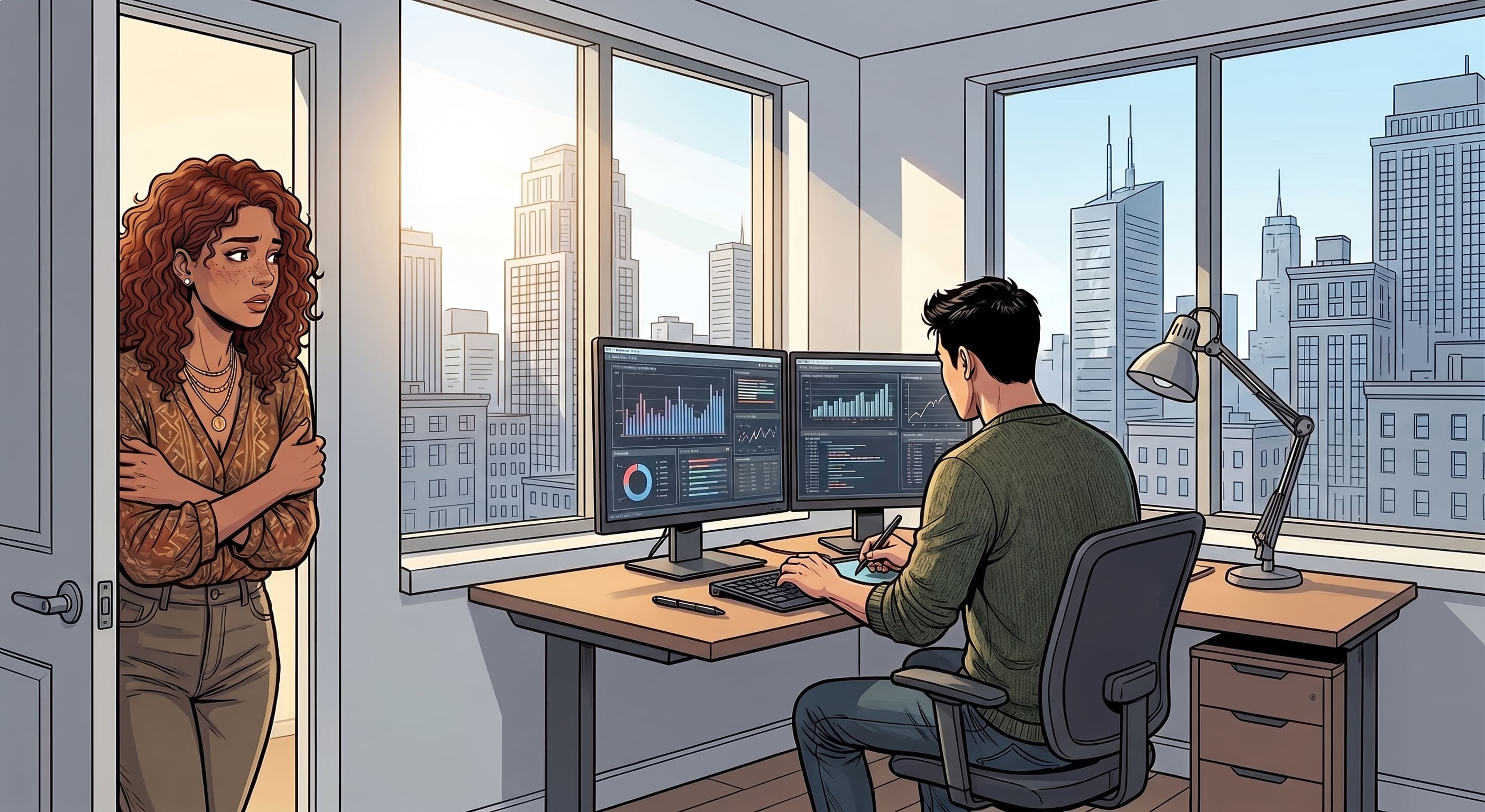
Nate has a rough week at work and goes quiet — not upset with Olivia, just genuinely worn out, and pulling inward is simply how he recharges. Olivia notices the quiet within the hour. To her, quiet has always meant something is wrong, so she sends a text to check in. When Nate doesn't reply right away, her read shifts from “something's wrong” to “something's wrong with us,” so she sends a second, softer message, trying to smooth over a problem she isn't even sure exists yet.
Nate sees both messages land while he's still trying to recover his own bandwidth. To him, the second text doesn't read as care — it reads as one more demand on the exact resource he's trying to protect. So he pulls back further, tells himself he just needs space, and goes quieter still.
Now they've both just confirmed their oldest fear. Olivia's takeaway: I reached out and it made things worse — I really am too much. Nate's takeaway: I asked for nothing and got pressure anyway — I really can't have space in this relationship. Neither one is wrong about what they felt in that moment. They're both wrong about what it actually means.
✎ What actually happened
Nate's silence was never a verdict on the relationship — it was a recovery habit that had nothing to do with Olivia.
Olivia's second text was never really about confirming their plans — it was an attempt to make an uncomfortable feeling stop.
The loop isn't caused by either of them being “too much” or “too distant.” It's caused by two automatic reactions responding to each other, instead of to what's actually happening.
Was It Ever Really Love?
Yes — and this is worth sitting with, because a lot of people walk away from an anxious-avoidant relationship assuming the whole thing was fake, or that they were somehow fooled. Usually neither is true. The connection and the chemistry were real. What wasn't there yet was the footing to make that connection sustainable — which is a completely different thing, and a fixable one.
Breaking the Loop From Either Side
If you're the anxious partner: the fastest way to interrupt this loop is to sit with the urge to reach out for about ten minutes before acting on it, and to ask yourself what you actually need underneath the urge — usually it's reassurance, not a resolved conversation this exact second.
If you're the avoidant partner: the fix isn't to override your need for space — it's to say so out loud instead of just disappearing into it. “I need an hour, I'll come back” does something for your partner's nervous system that silence alone can never do, because it turns an ambiguous absence into a stated, time-limited plan.
Early on, this can even feel like chemistry. Later, without anyone stepping outside the loop first, it's just exhausting for both people — which is exactly why naming the pattern while it's happening, instead of only after, is the whole skill worth building.
✎ Quick self-check
Do you recognize this loop, or a version of it — in a relationship you've been in?
1. One of us pulls back when things feel stressful, and the other reaches out more when that happens.
2. The reaching-out sometimes seems to make the pulling-back worse, not better.
3. We've both walked away from the same argument having learned completely opposite lessons from it.
4. Early on, the relationship felt unusually intense compared to how calm other parts of my life were at the time.
Buy This Guide
Lifetime access to this guide.
Unlimited All-Access
Unlock all current & future guides.